
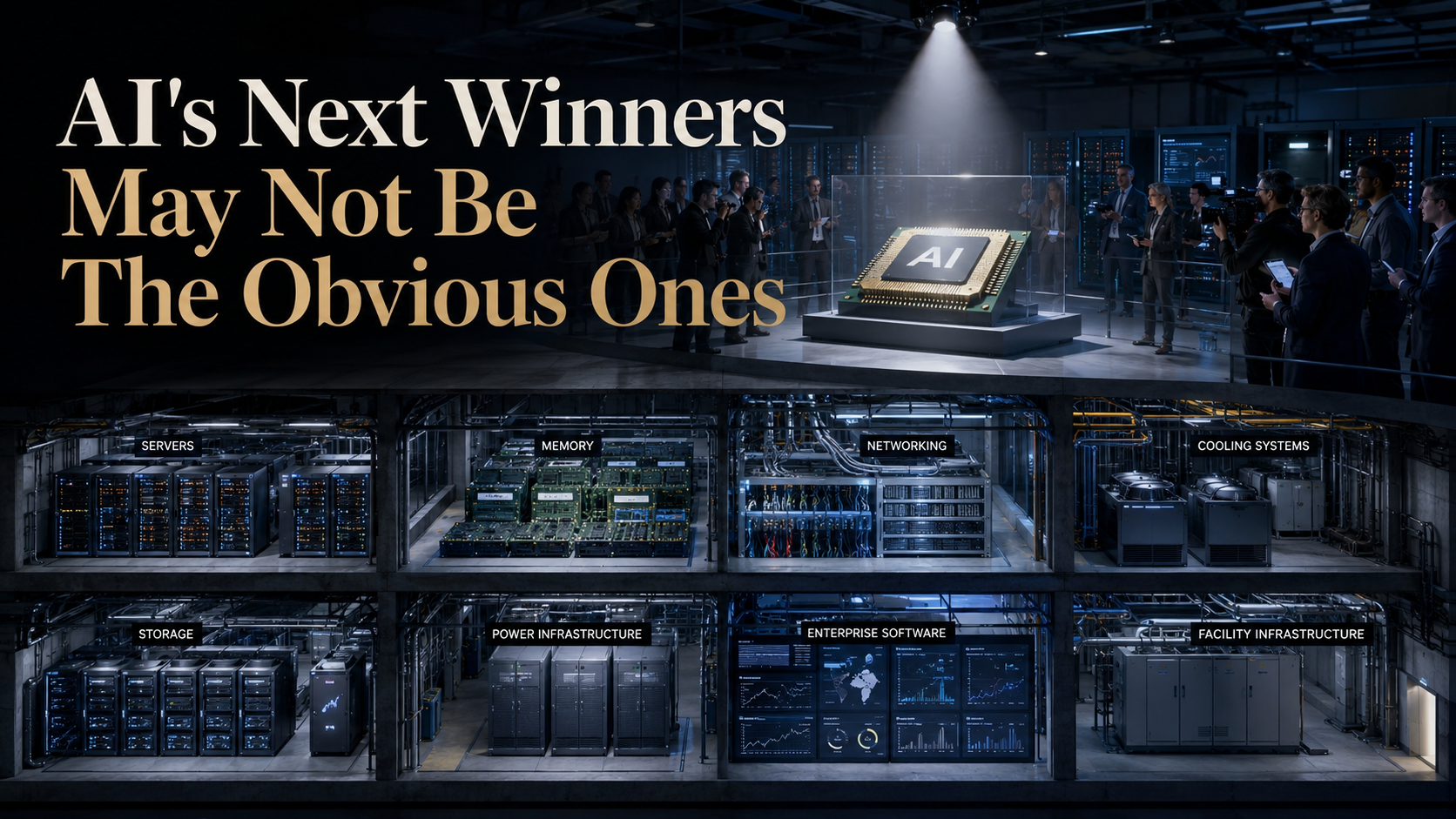
A new phase of the AI boom appears to be underway, and it is being driven by the companies enabling AI deployment at scale.
Increasingly, some of the most interesting moves are occurring one layer beneath the obvious AI headlines. Servers, memory, networking, cooling, cloud infrastructure, cybersecurity and enterprise software are becoming part of the same market leadership story.
The AI Leadership Story Is Expanding
Few companies have become more synonymous with the AI revolution than Nvidia. Its graphics processing units became the foundation of modern AI training and inference, helping propel the company into one of the largest businesses in the world.
Yet market leadership rarely remains concentrated forever. As AI adoption accelerates across industries, investors are beginning to focus on a different question: who benefits when AI moves from experimentation to widespread deployment?
The answer extends far beyond chip designers. Servers, memory manufacturers, networking providers, cloud infrastructure specialists, cybersecurity firms and enterprise software companies are all becoming critical pieces of the AI ecosystem.
In many cases, these businesses may be benefiting from trends that are only now becoming visible in the wider market narrative.
Dell's Results Show The Infrastructure Layer
One of the clearest signals came from Dell, which recently reported strong demand for AI-focused servers and a growing order backlog tied to artificial intelligence infrastructure. Investors responded enthusiastically, sending shares sharply higher.
The significance goes beyond a single earnings report. Building advanced AI systems requires enormous amounts of computing infrastructure. Data centres need specialised hardware, networking equipment, cooling systems, storage capacity and deployment expertise.
The market is increasingly recognising that every AI model requires a substantial supporting ecosystem. In other words, the AI boom is no longer just about creating intelligence. It is about delivering it reliably, securely and at scale.
Why Memory Has Become Strategic
Another area attracting investor attention is memory. Modern AI applications consume vast amounts of data, creating demand for increasingly sophisticated memory solutions.
As AI infrastructure spending accelerates, supply constraints are becoming more visible across parts of the semiconductor industry. That has helped fuel renewed interest in memory manufacturers, with investors recognising that AI systems are only as effective as the infrastructure supporting data movement and processing.
What was once viewed primarily as a cyclical component industry is increasingly being discussed as a strategic enabler of the AI economy. When technology trends move from experimentation to large-scale deployment, supporting technologies often become just as important as the headline innovation itself.
The Software Rebound Few Expected
Perhaps the most surprising development has occurred within software. Only a year ago, many investors feared AI would disrupt large parts of the software industry.
The assumption was that automation and AI assistants would reduce demand for existing enterprise tools. Instead, many software companies are discovering a different reality.
As organisations integrate AI into workflows, they create new layers of operational complexity. Businesses need governance systems, workflow automation, security controls, data management, monitoring tools, compliance frameworks and integration platforms.
Rather than replacing software, AI is often increasing demand for it. This shift has contributed to renewed strength across parts of the enterprise software sector, as investors reassess how AI adoption may influence long-term growth.
What Momentum Investors Should Watch Next
Markets tend to follow a familiar pattern. An emerging theme captures attention. Capital concentrates around a handful of obvious winners. Eventually, investors begin searching for the secondary beneficiaries.
That process can create entirely new leadership groups. The companies attracting institutional capital today may not be the same names that dominated headlines at the beginning of the AI cycle.
For momentum investors, this creates an important lesson: leadership is not static. The strongest trends often emerge as money rotates into adjacent sectors and previously overlooked beneficiaries.
Monitoring relative strength, earnings revisions, sector leadership and trend persistence can provide useful clues about where institutional investors are directing capital next.
Market Leadership Often Broadens Before It Peaks
Some of the most powerful investment themes in history have followed this pattern. The initial winners attract attention first. The supporting infrastructure companies emerge later. Then the theme broadens across the wider economy.
Today's AI market may be entering that next stage. While Nvidia remains a central part of the AI story, investors are increasingly looking beyond the obvious beneficiaries toward the businesses making large-scale AI adoption possible.
The biggest opportunities rarely remain hidden forever. But they often emerge after the crowd has already decided it knows where all the winners are.
Free Briefing: Track Where Market Leadership Is Moving
The strongest themes rarely move in a straight line. Get the ARX Momentum Briefing and learn how systematic investors think about leadership, rotation and strength without relying on headlines alone.
The lesson is not that investors need more noise. It is that they need a clearer process for deciding what deserves attention, what deserves capital, and when strength is actually showing up.
For a broader framework, read the Market Leadership Brief or explore the ARX Momentum Briefing.
The takeaway
The AI trade may be broadening from model builders and headline chip stocks into the infrastructure layer that makes AI deployment possible.
For investors, the useful question is not whether yesterday's winners still matter. It is whether new leadership groups are beginning to show stronger evidence of institutional demand.
This article is provided for informational and educational purposes only and does not constitute investment advice, financial advice or a recommendation to buy or sell any security. References to companies, sectors or themes are examples for market commentary only. Investments can fall as well as rise in value and investors may get back less than they originally invested. Past performance is not a reliable indicator of future results. Always conduct your own research and consider seeking independent financial advice before making investment decisions.
Common questions
What is phase two of the AI trade?
Phase two refers to the market broadening from the most obvious AI beneficiaries, such as headline chip stocks, toward the infrastructure companies that help deploy AI at scale. That can include servers, memory, networking, data centres, cybersecurity and enterprise software.
Does this article recommend buying AI stocks?
No. This is educational market commentary only. It is not personal financial advice or a recommendation to buy or sell any stock, sector or investment product.
Why does market leadership matter for AI investors?
Leadership can show where capital is moving inside a theme. When a trend broadens, investors may start rewarding supporting sectors and secondary beneficiaries rather than only the original headline winners.
ARX Market Desk publishes educational market commentary on momentum, investor behaviour, market leadership, and systematic investing. Articles are for information only and are not personal financial advice.